Big Bang (but not that one)
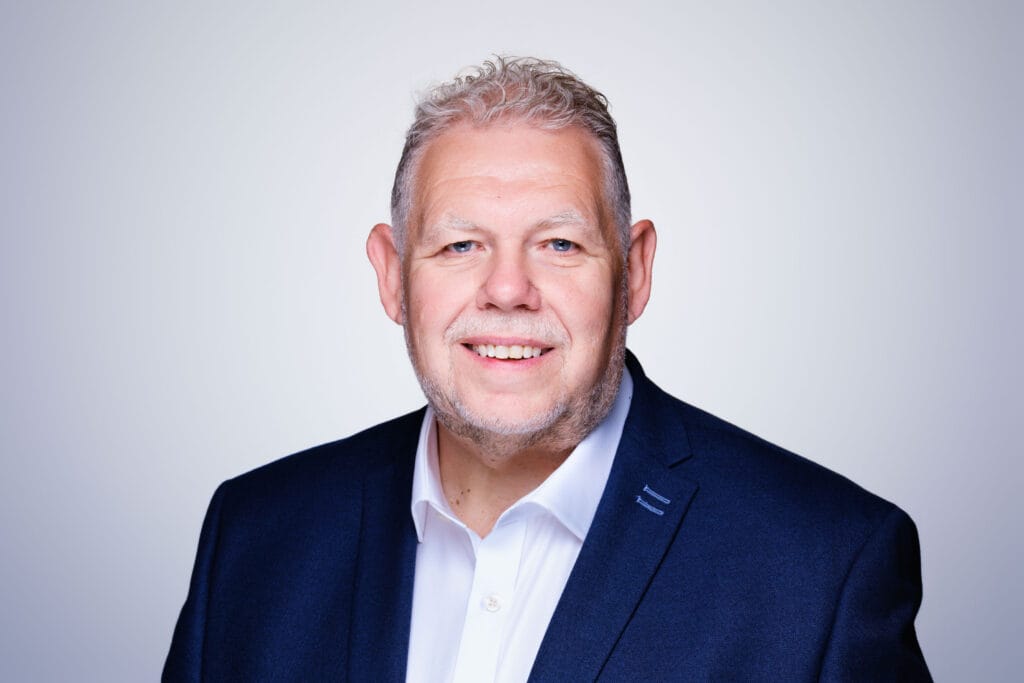
I’m old, but not quite that old. The Big Bang I’m talking about was the deregulation of London’s financial markets. At Merrill Lynch I started out as a Bond Sales Assistant and Futures Desk Trader — right in the thick of a “City” that had suddenly gone global.
Storms Ahead
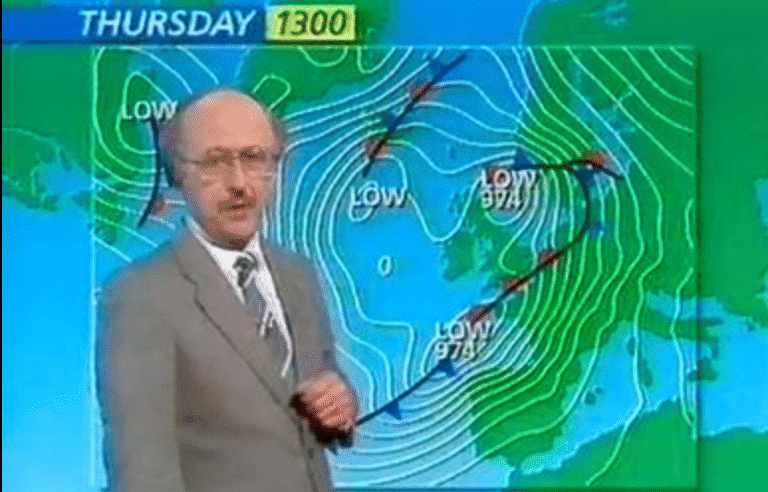
Michael Fish said there wouldn’t be a hurricane… then came the Great Storm. Days later, Black Monday shook global markets. At Fidelity Investments, I was in the middle of it all — learning fast how fragile markets could be, and why strong systems and controls mattered.
From Crash to Clarity
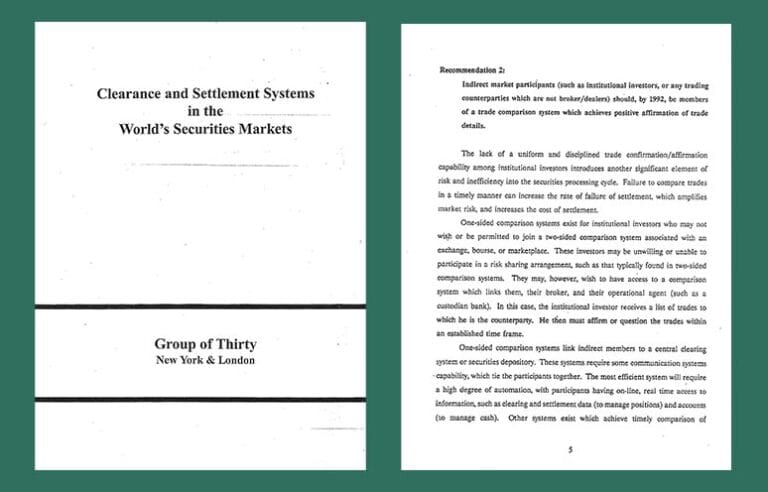
In the aftermath of Black Monday, the Group of Thirty published its landmark report on clearing and settlement. Buried on page 5 was Recommendation No. 2: trade confirmation and affirmation. For most, just another piece of regulatory text. For me, a spark. That one paragraph set the direction for the innovation that became Electronic Trade Confirmation — and defined much of my career.
An Unlikely Revolutionary
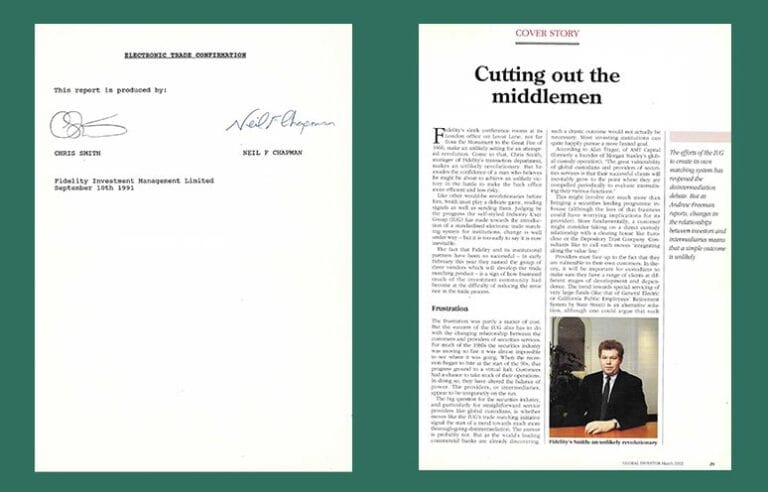
Facing globally fragile post-trade markets, and in the wake of the G30 report, I did what all fund managers do in a crisis… I arranged lunch. Out of those conversations came the first Electronic Trade Confirmation paper. By 1992, the industry was taking notice. Global Investor ran a feature calling me an “unlikely revolutionary” — not a title I’d have chosen, but one that captured the change ETC was about to bring.
Blueprint for Innovation
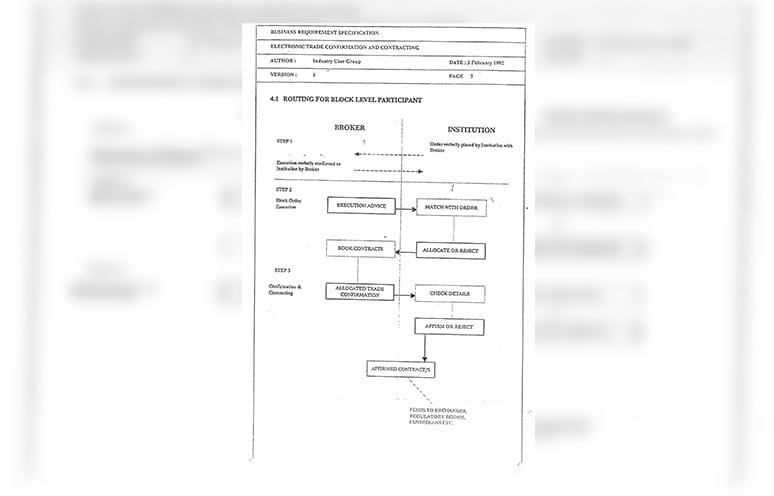
Bringing together banks, brokers and fund managers, we designed the first industry-wide workflow for electronic trade confirmation. This blueprint set the stage for three commercial services — ISMA’s TRAX, the LSE’s SEQUAL, and Thomson Financials’ OASYS Global — shaping the innovation that redefined post-trade markets. As an aside to all this, a direct result of the ETC initiative, SWIFT took the unprecedented step of granting fund managers access to its global payments network — a breakthrough that had been resisted until then
From Blueprint to Execution
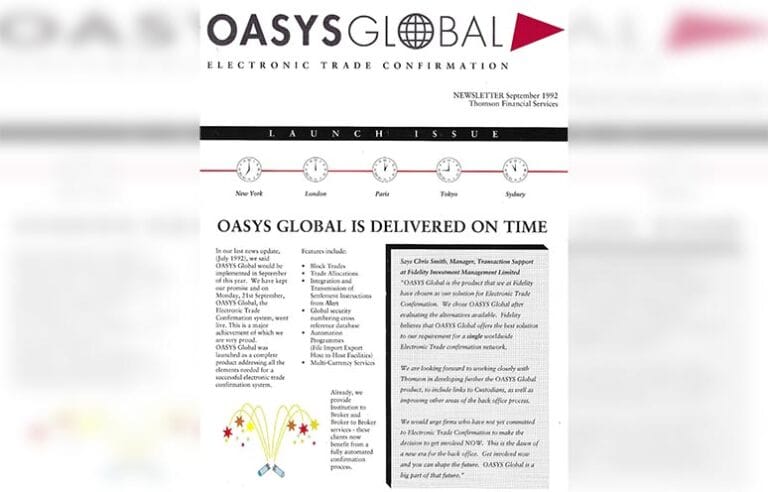
In September 1992, whilst at Fidelity, I carried out the first-ever trade confirmation on OASYS Global — an equity trade between Fidelity and Smith New Court in Electrocomponents for the Fidelity Special Situations Fund . But one successful trade wasn’t enough. To make sure ETC wasn’t a one-hit wonder, I took a leap of faith and moved to the vendor side at Thomson Financial. My mission: to build the community, win over the sceptics, and turn ETC from an experiment into an industry standard.
Taking Innovation Global
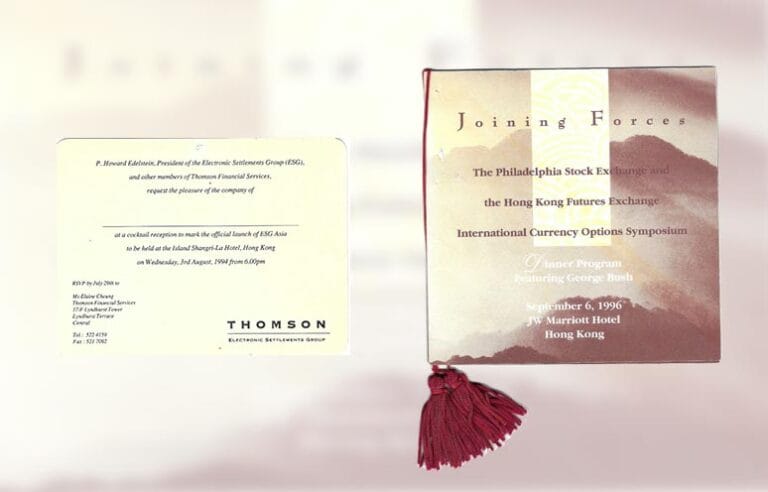
In 1994, I moved to Asia to help make Electronic Trade Confirmation (ETC) a truly global standard. What started as a European initiative was now being adopted in Hong Kong and across Asia, with new communities of brokers, fund managers, and custodians coming on board. It was about more than just technology — it was about building trust and creating a global language for financial markets.
Fun fact: In 1996, I had the honour of being a guest at a dinner in Hong Kong for former U.S. President George H.W. Bush. I was invited by Hon. J. Carter Beese, a former SEC Commissioner and strong ally of Thomson Financial. He memorably said: “Nothing good happens to a trade between Trade Date and Settlement Date.” It captured the urgency of the time, as global markets not only looked to improve automation but pushed settlement cycles from T+5 to T+3 and beyond — a journey that continues today as we move toward T+1.
The STP Years – From Rivalry to Resolution
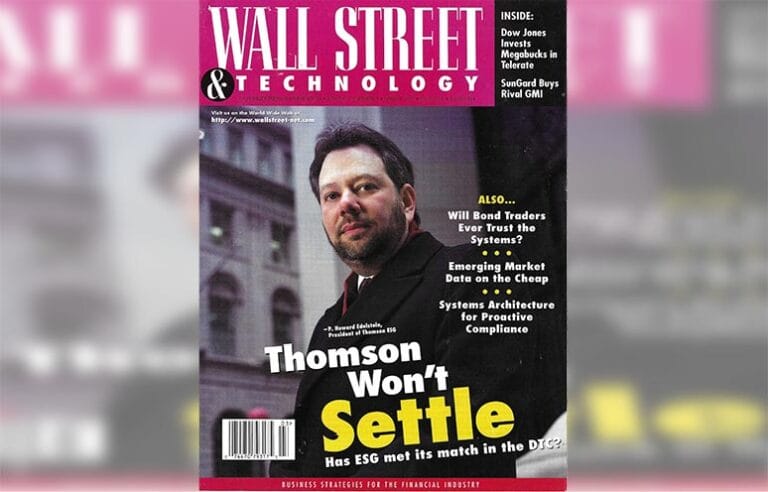
The late 1990s were defined by the race to achieve Straight Through Processing (STP) — the seamless automation of a trade from execution through to settlement, eliminating manual breaks and risks along the way. ETC was one vital piece, but the ambition was much bigger: global standardisation, interoperability, and trust. In the U.S., the DTC invoked NYSE Rule 387, a regulation that gave them a theoretical lock on confirmations. At the same time, the industry began forming the GSTPA, a competing initiative built around the then-new SWIFT ISO15022 messaging standards. With Thomson’s OASYS and other electronic platforms gaining adoption, the landscape risked fragmenting. The turning point came in 1999. After months of industry debate, DTC and Thomson Financial — former rivals — came together in New York to agree a joint venture. That joint venture became Omgeo, an entity that went on to become the global leader in trade confirmation and post-trade efficiency.
Why it Mattered: This wasn’t just about systems — it was about trust and collaboration across a fragmented global industry. Helping shape the transition from rivalry to resolution showed me the power of building consensus at scale.
Innovation Signed Off
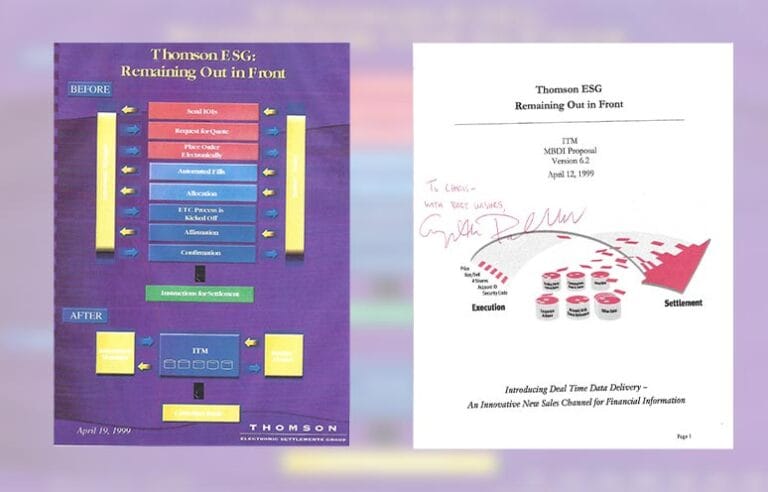
At an offsite in Israel in 1998, I sketched out an idea I called Intelligent Trade Management (ITM) — using enriched data from trusted sources to get trades 100% right within seconds of execution. Bold at the time, it embodied the ambition of Straight Through Processing. By April 1999, that idea became a Thomson Major Business Development Initiative (MBDI), with $50m signed off by the Thomson Corp. ITM not only secured the strategic joint venture with DTC, but ultimately evolved into CTM –Central Trade Manager — still the backbone of global post-trade today.
On the way to present the plan, I explained it to Gwyneth Paltrow who I met in the Heathrow BA Lounge on the morning after she had attended the 1999 BAFTA – a few weeks after her tearful acceptance speech for Best Actress at the Oscars for her role in Shakespeare in Love. She wished me luck with the pitch, signed the cover page of my business plan. That signed copy became the introduction to our board presentation. A touch of Hollywood magic in the world of settlement plumbing.

From Floor & Phone to Screen and Bytes
The early 2000s saw the swaps market begin its digital evolution. What had once been confirmed by voice and long-form ISDA contracts started shifting toward electronic confirmation and affirmation. While at Tradeweb, I ran the product that created the very first electronic ISDA Short Form confirmation. Building on that success, I worked collaboratively to link electronic trading of interest rate swaps on Tradeweb with Swapswire — which via Markit is now part of OSTTRA, the global leader in post-trade solutions for derivatives.
Riding the Regulatory Wave
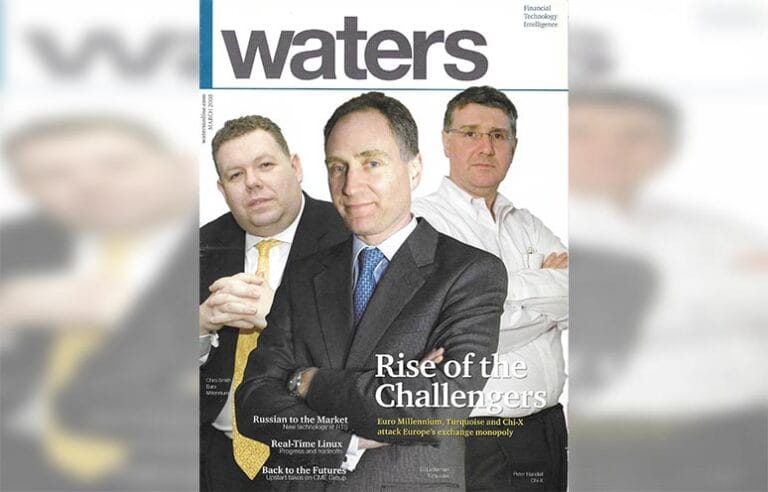
With the arrival of MiFID I in 2007, Europe’s market structure was being rewritten — and opportunity was everywhere for those ready to seize it. I built the business plan for Euro Millennium and secured backing from NYFIX’s CEO Howard Edelstein and its investors, Warburg Pincus, to bring the vision to life. As CEO (holding the CF3 designation), I not only drove the strategy and business build but also took direct responsibility for regulatory, compliance, and risk oversight. Euro Millennium became one of the new breed of alternative trading venues, including the growth of Dark Pools and Algos, reshaping the competitive landscape of European equities.

From Regulation to Reinvention
With MiFID II reshaping Europe’s markets, I led the development of MarketAxess’ post-trade service offering —building solutions that eventually helped over 1,000 firms meet their regulatory and operational challenges. Beyond compliance, my focus was on innovation: turning mandatory change into opportunities for efficiency, transparency, and growth. I was accountable for the risks of the business, reporting directly to both the UK and EU Boards while scaling MarketAxess Trax into one of Europe’s most trusted regulatory post-trade platforms.
In 1992, Trax was one of the three vendors chosen by the Industry User Group (IUG) to build out Electronic Trade Confirmation. Fast forward more than two decades, and I found myself running Trax after its acquisition by MarketAxess. Life has a funny way of looping back — I’d gone from helping to choose Trax to being responsible for leading it. Proof, perhaps, that in post-trade, nothing ever truly settles.

A Lifetime of Innovation (So Far…)
In 2008, I was honoured with a Lifetime Achievement Award from Operations Management (part of Institutional Investor / Euromoney) for my work on Electronic Trade Confirmation. Normally, these awards are given when the story is over — but I’ve never believed in “settling.” For me, it was a recognition not of an ending, but of a way of working: challenging the status quo, asking the awkward questions, and pushing for change even when it wasn’t comfortable.
Today, I bring that same lifetime of experience to helping firms:
- Learn what success really looks like
- Build great products and drive true innovation
- Manage and even capitalise on risks
- Put effective controls in place that power performance, not hinder it
Above all, I remain committed to the same principle that has defined my career:
keep innovating, keep creating, and never “settle”.